A Brief History of Snowboarding
With an emphasis on its roots in Vermont
Snowboarding is a sport enjoyed by millions around the world, but it was only 60 years ago when Sherman Poppen, to keep his daughters occupied on Christmas Day, 1965, nailed two skis together so they could slide down a little hill in their yard in Muskegon, Michigan. With that spark of innovation, Sherman saw potential and began to refine his idea. Looking for a name for his new contraption, his wife Nancy blended ‘snow’ with ‘surf’ and came up with Snurfer. Over the next 20 years, what began as a backyard toy became the global snowboarding phenomena.
There were other efforts many years before that event, some were even commercialized. They all share a similar design concept with a sideways stance and something coming off the nose of the board. All are similar to what we know today, but none caught on the way the Snurfer did.
What this page attempts to do is show a summary of the key events in the early history of snowboarding. Most of this can be found spread around the internet but we think this is currently the only place where we try and tie it all together.
Pre 1900
The earliest known existence of something that looks like snowboarding took place on the Petran Plateau in the Rize Province of Turkey where they’ve ridden wide wooden boards with a rope off the nose called a Lazboard for several hundred years!
The recent documentary Foothills, the Unlinked Heritage of Snowboarding, dives into its history. Snowboarder Danny Davis has visited the region and there is now an annual Lazboard Festival to celebrate their local heritage. You can find several other videos on YouTube about the Lazboard.
1900-1950
More recently, but still well before its popularity skyrocketed, there were a few attempts in the early 1900’s to develop a snowboard like product. Vern Wicklund, Gunnar Burgeson and Harvey Burgeson of Oak Park, Illinois, designed a board that had all the elements of early snowboards including a strap for the back foot and a rope coming off the nose. It was reportedly designed somewhere around 1916 but they patented it much later in 1939. (read the patent here)
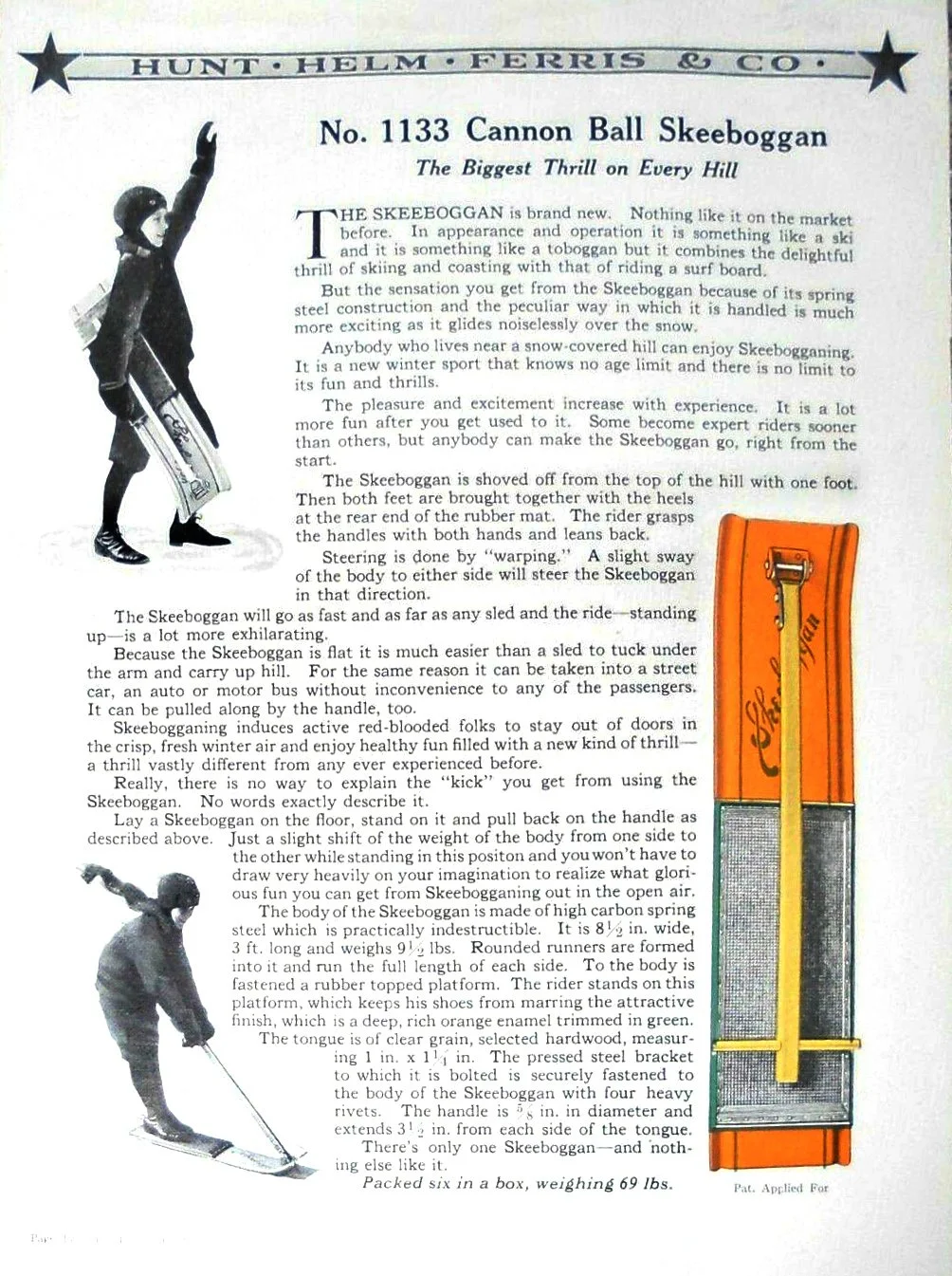
Around the same time, Howard Ferris of Harvard, Illinois, patented a ‘coasting device’ in 1926. This product, called the Skeeboggan, had a stamp steel board with a wooden platform on it for the feet and a wooden handle coming off the front to hold onto. This product was commercialized and sold via retailers. The Museum has one of these in the collection and it is heavy and one would hope that it didn’t hit you if it got loose! (read the patent here)
With both of these coming out of Illinois around the same time, one wonders if there might be some connection.
1965
Sherman Poppen, to keep his daughters occupied on Christmas Day, 1965, nailed two skis together so his girls could slide down a little hill in their yard in Muskegon, Michigan. With that spark of innovation, Sherman saw potential and began to refine his idea. Looking for a name for his new contraption, his wife Nancy blended ‘snow’ with ‘surf’ and came up with Snurfer. Over the next 20 years, what began as a backyard toy became the global snowboarding phenomena.
The Dawning by East Street Archives documents the transition from Snurfing to Snowboarding and the role Paul Graves played in those early years.
1966
Poppen licenses the concept to Brunswick Corp (think bowling alleys and pool tables) who introduces the Snurfer for $10. They use material from their pool tables to make them.
Paul Graves receives his first Snurfer
1968
Hosted by a college fraternity from Muskegon Community College, the first organized Snurfer contest, The World Snurfing Championships, is held on February 19th at Blockhouse Hill in Muskegon State Park in Michigan. There were 300 participants!
Sherman Poppen receives patent approval on his Snurfer from the U.S. Patent and Trademark Offices. (read the patent here)
1970
Paul Graves begins association with Brunswick Corp and becomes the first ‘pro’ snow surfer.
1971
Over 300,000 Snurfer boards have already been sold.
1972
Brunswick stops production of the Snurfer to focus on their core businesses, bowling and billiards.
Dimitrije Milovich, founder of Winterstick Snowboards, makes his first ‘snow surfboard’ prototype in Utah.
1973
Recognizing that the SNURFER had demand, a couple of Brunswick executives broke away and formed the JEM Corporation and took over SNURFER production and promotion.
Paul Graves takes an active role in beginning to demonstrate at ski areas exploring the possibilities of gaining access
1975
Paul began doing demonstrations nationwide and coming up with design modifications for new Snurfer models.
Robert Weber is granted a patent for a ‘mono-ski for use on snow’ where the user is positioned like on a snowboard. (read the patent here)
Jake Burton Carpenter begins modifying his Snurfer.
1976
After making skateboards for himself and friends, Tom Sims incorporates Sims Skateboards in Santa Barbara, California and sells his first ‘Skiboard’ the same year.
Dimitrije Milovich incorporates Winterstick Snowboards in Utah.
1977
Jake Burton Carpenter founds Burton Snowboards in Londonderry, Vermont.
Mike Olsen starts making Gnu Snowboards in Washington state.
1978
JEM Corp., who has the license to make Snurfer Boards, become the official sponsor of the Snurfer Nationals by offering $1,000 in cash to the top finishers, the first event to do so. 1st place received a $400 prize.
JEM Corp. creates the National Snurfer Association. Members receive the Snurfer News newsletter, the first publication to focus on snow surfing.
1979
24-year-old Jake Burton Carpenter arrived with a snowboard of his own design. It had revolutionary foot straps and a P-Tex base. These controversial modifications resulted in the creation of an Open Division for riders who were using a board other than a Snurfer.
“At the ’79 championship, a guy from Vermont showed up in Muskegon with a modified Snurfer. It had a binding that secured the rider’s boots to the board. I recall him arguing with the race officials. He claimed that he should be allowed to compete, even though he had made modifications to his Snurfer.” Stewart McFerran
Jake Burton Carpenter would be disqualified from competing with this new type of Snurfer, but with a help from Paul Graves, JEM Corp’s sponsored rider, he was allowed to race in a special ‘open’ category made that the organizers created for him.
Paul Graves puts on a freestyle performance including multiple 360 spins in the downhill. Freestyle riding becomes part of the vocabulary. The performance caught the attention of an ad agency who later featured Paul in a TV commercial for LaBatt’s Blue beer and the new winter sport of Snurfing.
Nor Cal locals Bob Klein, Terry Kidwell, Allen Arnbrister and Mark Anolik begin riding a trench near a landfill near Truckee, CA. The spot gets named the Tahoe City Pipe.
1980
Jake Burton attends the National Snurfing Championships again as the competition site is moved to Pando Ski Hill in Rockford, MI with a 600 foot' run and added slalom event in addition to the downhill of previous years. The move is made to ensure better snow conditions.
Doug Bouton of Bondville, VT wins the slalom.
Paul Graves relocates to Woodstock, VT and opens Snowboard East which is the first shop exclusively selling Snurfers and promoting the sport. He creates the first snowboard team that gives Snurfing demonstrations.
1981
Chuck Barfoot splits from Sims and starts Barfoot Snowboards.
Blake Barrymore, son of ski filmmaker Dick Barrymore, appears in Canadian Mountain Odyssey as Ted Shred. Having never ridden a snowboard, Blake uses a Burton Board and make huge powder turns and slices through a group of skiers before blasting straight down the hill. According to Blake, they calculated his speed at around 80 miles per hour. Blake never rides a snowboard again.
Burton moves from Londonderry, Vermont to Manchester.
1982
Paul Graves creates and holds the first National Snow Surfing Championships at Suicide Six (now Saskadena Six) near Woodstock, Vermont. This is the first time that the ski industry allows the snow surfing /snowboarding community to use their slopes. The official sponsors were Snowboard East, The Woodstock Inn & Resort, Suicide Six and The Woodstock Recreation Center.
Avalanche Snowboards founded in Lake Tahoe, California by Chris and Bev Sanders. Chris’s brother Damian helped put the company on the map.
1983
Paul Graves gifts the National Championships event to Jake Burton to grow it while he explores other ways to promote snowboarding. Jake moves it to Snow Valley near Manchester, Vermont, where it is held in ’83 and ’84.
JEM Corp stops producing the Snurfer.
Steve Derrah who had been making Flite Skateboards in Rhode Island since 1974, begins making Flite Snowboards.
Ernie DeLost and Doug Baxendell also started making snowboards in Rochester, NY under the Snowtech brand.
David Kemper makes the first Kemper Snowboard in Ontario, Canada
The first European brands begin to appear including Hooger Booger and Apocalypse Surf.
Jake, Mark Heingartner and Andy Coghlan demonstrate snowboarding to Paul Johnston, the GM of Stratton Mountain. Going against his board of director, Johnston decides to allow snowboards on the lower slopes of the mountain.
Tom Sims organizes the first halfpipe competition known as the World Championships, at Soda Springs, CA.
1984
The National Snowboarding Championships is held at Snow Valley in Manchester, Vermont.
Bob Novack from Muskegon, Michigan wins the downhill event at Pando beating some who would become legendary Burton team riders including Andy Coghlan, Mark Heingartner, and Chris Karol. Coghlan of Manchester Center, VT, wins the slalom.
The Swingbo, a cross between snowboarding, skiing and skateboarding, appears in Germany and Austria. Paul Graves introduces the Swingbo to North America. It gains some ski area acceptance with metal edges and a leash attachment but ultimately fades away.
1985
Burton hosts the first US Open of Snowboarding at Stratton Mountain, Vermont.
Burton introduces the Burton Performer Elite, the first production snowboard with a P-Tex base and metal edges.
Tom Hsieh debuts International Snowboard Magazine (ISM).
1986
French company Look launches the Trick Stick, renamed the Bert Lamar Trick Stick two years later.
1987
Chris Karol and Andy Coglan start the New England Cup competiton series.
1988
A halfpipe is added to the US Open of Snowboarding.
K2 and Rossignol ski brands introduce their own snowboards.
Black Snow introduces a $30 plastic snowboard for the mass market.
1989
Craig Kelly’s first US Open Halfpipe win.
Suzi Rueck starts the Allegro instructional program at Stratton.
Mervin Manufacturing is formally established for the Gnu brand.
1990
Snowboarding reaches one million participants and reaches approximately 10% of snowsports participants.
Jeff Brushie from Hinesburgh, becomes World Champion.
Terje’s first US Open Appearance.
Craig Kelly’s second US Open halfpipe win.
Mervin introduces the Lib Tech brand.
Mammoth Mountain holds the first ‘Big Air’ competition.
Then Stowe resident Neil Korn begins publishing Eastern Edge snowboard magazine.
1991
Betsy Shaw of East Dorset wins the slalom at the US Open.
1992
Burton moves from Manchester to Burlington, Vermont.
Terje’s first US Open Halfpipe win.
Craig Kelly retires from competitive snowboarding to focus on free riding.
1993
Brushie gets a pro model Burton board.
1994
The Air and Style contest is first held in Innsbruck, Austria.
1995
‘Peak Snowboard Mania’ as there are roughly 300 brands of snowboards available globally.
1996
FIS, the international ski federation, holds the first World Snowboarding Championships in Lienz, Austria. The battle for control of competitive snowboarding begins.
Shannon Dunn gets the first women’s pro model for Burton.
1997
The first Winter X Games are held at Snow Summit in California.
Hayes Brothers Snowboards launched in Londonderry.
1998
Snowboarding becomes a full medal sport in the Nagano Olympics. Giant slalom and halfpipe are the two events.
2000
Snowboarding reaches 30% of snowsports participation. It has roughly stayed the same since.
The number of snowboard brands shrinks by more than 50%.
For more on specific board history, try these links:
The history of the Lazboard, possibly the first type of snowboarding anywhere in the world, and they’ve been riding them for over 300 years!
The Burgeson/Wicklund ‘sled’ that was patented in 1939. There are a lot of similarities to early snowboards.
The Story of the Snurfer, as told by the inventor, Sherman Poppen.
Footage of the Snurfer Nationals held in Muskegon, Michigan.
Some early Snurfing footage.
Julie Poppen talks about her father.
Snowboarding went global quickly. This feature from a Swiss broadcaster from 1981 features some of the pioneers in Europe.
Ted Shred segment of Canadian Mountain Odyssey, 1981
The Story of Ted Shred as told by filmmaker Dick Barrymore.
Apocalypse Snow, released in 1983 by the Les Arcs resort in France and featuring snowboarder Regis Rolland along with some crazy mono-skiers. There is also Apocalypse Snow II and III released over the next couple of years with a few excellent snowboard sequences.
A classic! We weren't well received at first!
Burton’s first promo video, Winter Waves, released in 1985
Sim’s Snowboards ‘Snow Shredders’ from 1986 featuring Terry Kidwell, Shaun Palmer, Bert Lamar and other Sims team riders. Craig Kelly can also be seen, although he is not mentioned in the team credits.
Burton’s second promotional video, One Track Mind, released in 1987
The Western Front, the first video from Fall Line Films, was set in Northern California and was one of the first inde films in snowboarding.
Adventurscope Productions 1989 Board with the World, featuring Craig Kelly and many other Burton team riders including Jeff Brushie, Jason Ford, Mike Jacoby and Keith Wallace.
Some love for the Bromley Glebeland crew from 1992!
Feature 3
In sit amet felis malesuada, feugiat purus eget, varius mi. In sit amet felis malesuada, feugiat purus eget, varius mi.